


Choosing a Shuttle Is a Design Decision, Not a Product Decision
Two operations can buy the identical pallet shuttle carrier and end up with completely different results. One hits its throughput target and pays back the rack investment. The other sits idle half the shift while forklifts queue at the lane face. The carrier was never the variable. Lane depth, SKU count and storage temperature decide the outcome, and those are design inputs, not catalogue options.
This article sorts shuttle systems into three families, then gives you a decision table that maps SKU count, lane depth and temperature to the right family. After that, it shows how to calculate pallets per hour before you accept a quote, because most disappointing installations were mis-sized at the concept design stage, not badly built. Treat this as the reference page the rest of our shuttle articles build on.
What a Pallet Shuttle System Is and Which Operations Run One
A pallet shuttle system is a motorised carrier that travels on rails built into the rack, inside a deep storage lane. It lifts a pallet, runs it to the lane face or to a set position, and hands off to a forklift, a lift, or a conveyor. The machine lives in the grid, not in an aisle.
How the carrier and rails work together
Rails are part of the rack structure, carrying both the pallet load and the shuttle itself. The carrier raises the pallet clear of the rails, moves under it, and sets it down against the lane stops. Positioning accuracy depends on rail tolerance and frame alignment, which is why rack installation tolerances matter more here than in static racking.
Why removing aisles raises cube utilisation
Every aisle is floor area that stores nothing. Pushing storage into lanes 10 to 40 pallets deep converts that area into positions, and the shuttle removes the reach limits that make drive-in racking so slow to load. Cube utilisation rises without raising the building.
Typical load profiles and industries
Beverage and food distribution with few SKUs and high case volume, 3PL bulk storage, raw material and finished goods buffers in manufacturing, and cold stores where every cubic metre is refrigerated. Our pallet shuttle range covers those duty profiles.
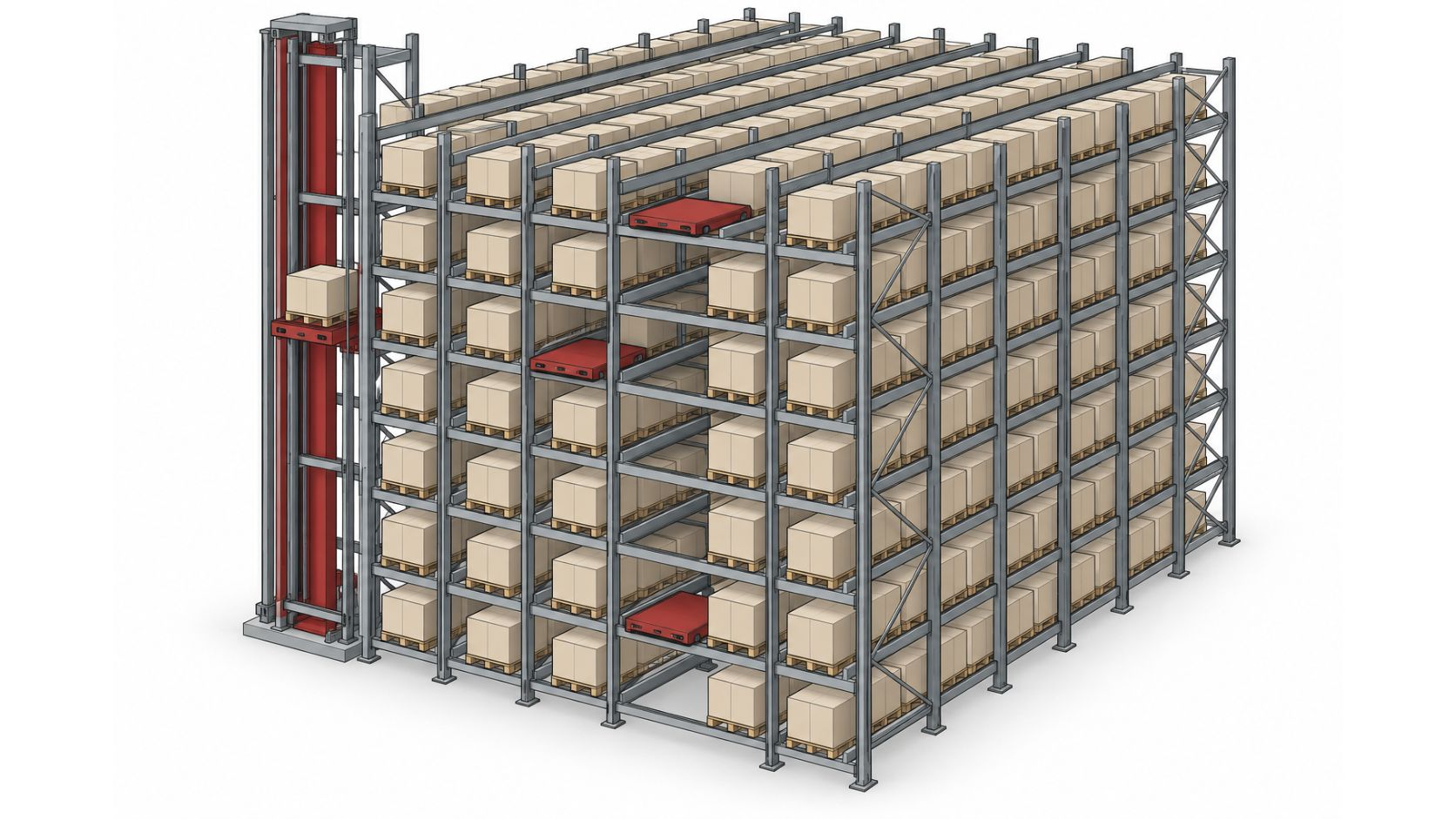
Semi-Automated Pallet Shuttles: One Carrier, Many Lanes
How a pallet shuttle is controlled
A forklift or reach truck lifts the carrier, sets it on the rails at the lane mouth, and loads pallets at the entry position. The operator then drives the carrier with a handheld remote or tablet, which is why the market calls it a pallet shuttle rather than a shuttle under warehouse control software. Commands are simple: take the pallet in, compact the lane, present the next pallet. Units such as the FPSS1500B pallet shuttle come in payload classes typically quoted in the 1,000 to 1,500 kg band, with lane depths confirmed per project rather than assumed from a datasheet.
Where the throughput ceiling sits
The constraint is the truck, not the carrier. Every cycle waits on a driver, and relocating the carrier between lanes costs minutes each time, which turns aisle layout and forklift travel distance into the real throughput variable. A semi-automated pallet shuttle cannot outrun its operator.
When one carrier per aisle is enough
It works when SKU count is low, lanes are deep, and daily pallet moves are modest. Capital per pallet position stays low because one carrier serves dozens of lanes and the existing fleet keeps working.
Fully Automated Shuttle Systems With Dedicated Lifts
One carrier per level versus one per aisle
The step up is structural. Instead of one carrier moved between lanes, a carrier is assigned to each storage level and stays there permanently. Vertical lifts at the rack face handle level changes, and conveyor or AGV transfer moves pallets to dock or production. Throughput stops being a fixed property of the equipment and becomes a design variable: add carriers, add lifts, add transfer aisles, and the curve moves. One carrier per aisle serving all levels through a lift costs less and suits deep storage with moderate flow. One per level costs more and earns it back only where order profiles demand parallel picking across heights.
How lifts and transfer conveyors set the cycle rate
The lift and the transfer loop, not the shuttle, usually cap the system. A carrier that completes a retrieval faster than the lift can accept it simply waits. Real cycle rate comes from the warehouse control system sequencing carrier, lift and conveyor movements so queues never form. Ask any vendor for throughput under your actual dwell and buffer assumptions, not peak carrier speed.
FIFO or LIFO: what the lane layout decides
Single-entry lanes give LIFO. Through-lanes with load and unload faces give FIFO, essential for dated stock. Either way, forklifts leave the storage block entirely, which removes the dominant source of rack impact damage.
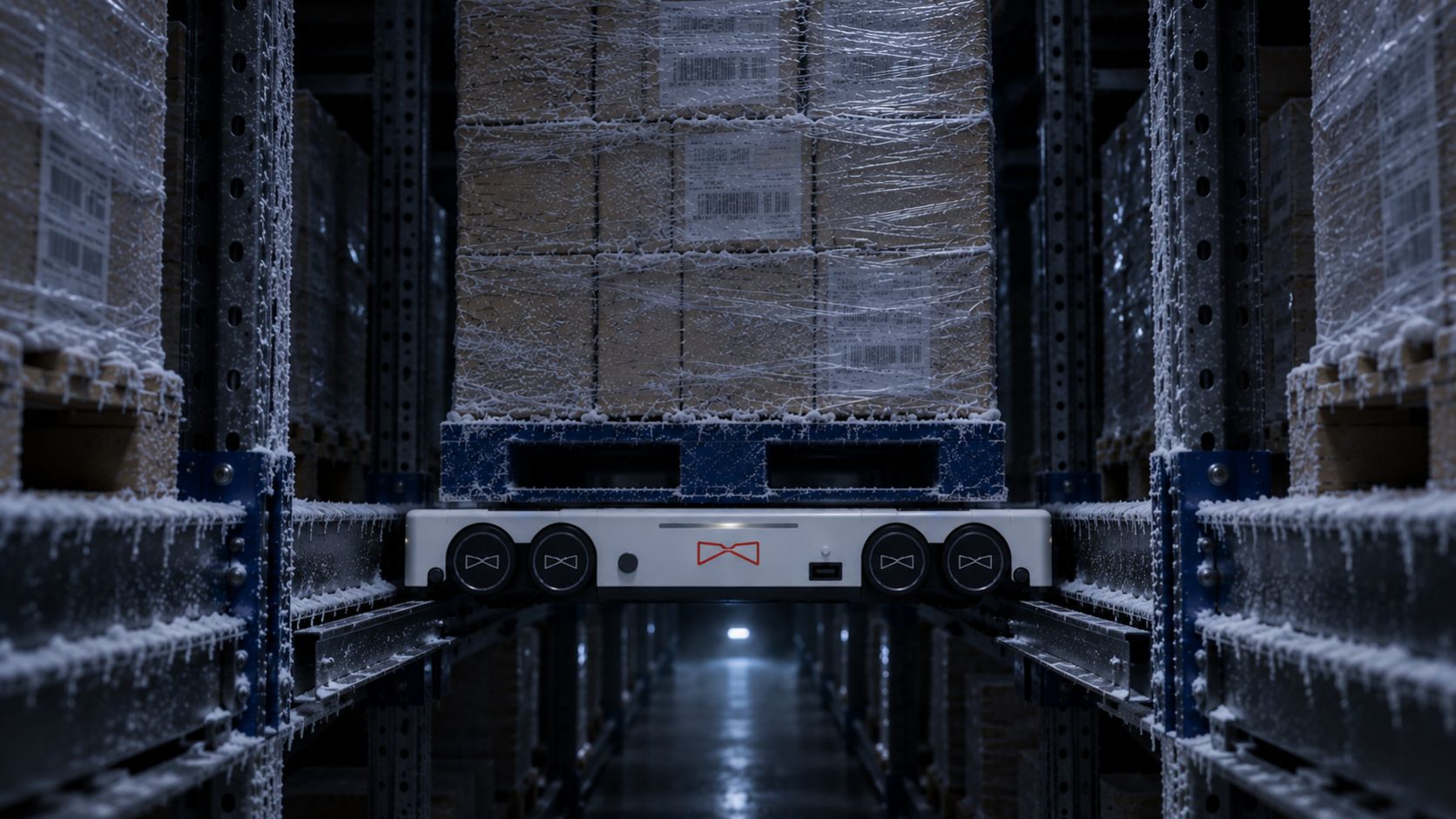
Four-Way Shuttles: When Lanes Alone Are Not Flexible Enough
How grid travel differs from lane travel
A single-direction carrier lives in one lane until a forklift or transfer car moves it. A four-way shuttle switches its wheel sets to travel along the lane and across the cross aisle, so one carrier serves many lanes on a level and, paired with a lift, many levels. The rack becomes a grid rather than a set of isolated channels, which is why the FPSS1500A four-way shuttle is specified where lane assignment changes weekly.
SKU count versus deep-lane density
Deep-lane storage rewards few SKUs holding many pallets each, because a lane should ideally hold one SKU. Push SKU count up and lanes sit part-empty, so cube utilisation falls even though the racking has not changed. Grid travel lets you build shorter lanes across more positions, holding far more SKUs at density a drive-in system cannot match.
What direction changes cost in cycle time
Every rotation consumes seconds, so pallets per hour per carrier sits below a dedicated single-direction shuttle. Rack tolerances tighten too, since the carrier must cross rail joints in both axes. Buy flexibility deliberately, not by default.
Decision Table: Matching Shuttle Type to SKU Count, Lane Depth and Temperature
Use the bands below to narrow the shortlist before layout work starts.
| Shuttle type | SKU count band | Lane depth | Temperature | Rotation | Relative throughput |
|---|---|---|---|---|---|
| Semi-automated pallet shuttle | Low, few SKUs per lane | Deep (roughly 10 to 40 positions, 12 to 50 m) | Ambient, chilled, frozen with cold-rated packs | LIFO, FIFO with dual access | Lowest, forklift-dependent |
| Fully automated with lifts | Low to medium | Medium to deep (8 to 30 positions) | Ambient to frozen | LIFO or FIFO by aisle design | High, continuous |
| Four-way shuttle | Medium to high | Shorter (4 to 12 positions) | Ambient to frozen | FIFO, selective | High, flexible routing |
Density rises with depth, selectivity falls. Final figures come from simulation of your order profile.

Sizing Throughput Before You Sign: How to Get to Pallets Per Hour
Annual tonnage tells you nothing about how many carriers and lifts you need. Peak-hour movement does. Size the system against the busiest hour of the busiest day, then split that figure into inbound full-lane replenishment and outbound single-pallet retrieval, because the two consume machine time very differently.
Which numbers a supplier needs from you
- Inbound and outbound pallets in the peak hour, separated, not blended into a daily average.
- The share of picks that pull one pallet from a lane versus emptying it.
- Pallet dimensions, weight and condition, since poor pallet quality drives rejected cycles.
- Dwell time allowed at the transfer point before the conveyor or truck backs up.
- Shift pattern and the window available for replenishment.
Why the lift is usually the bottleneck
Carriers can be added lane by lane. Lifts cannot. Every pallet entering or leaving a multi-level structure passes a lift, so lift cycles per hour cap the whole system. Model it explicitly during discrete event simulation rather than trusting a nameplate figure.
Lane depth versus retrieval travel time
Deeper lanes buy density and cost seconds per retrieval. A lane one pallet too deep strands stock behind slow movers, forcing rehandling that no cycle-time calculation predicted.
Running Shuttles in Chilled and Frozen Stores
What changes for components below freezing
Chilled duty around 0 to 5 degrees Celsius and deep-freeze duty at minus 25 tolerate very different specifications. Standard greases stiffen, drive torque rises, and seals harden. Lithium cells lose usable capacity and charge acceptance as temperature drops, so charging windows either lengthen or move outside the cold envelope. Specify low-temperature lubricants, heated enclosures for control electronics, and cabling rated for cold flex testing rather than assuming an ambient-rated carrier will cope.
Condensation, ice and rail maintenance
The damage happens at the boundary. Every transition between the cold store and a warmer dock drives condensation onto rails, pallet bases and optical sensors, which then freezes. Fogged scanners misread, ice on rail flanges causes wheel slip, and frost on bottom boards lifts pallets off datum. Airlocks, dehumidified anterooms and a defined rail inspection interval matter more than carrier speed ratings.
Why density matters more in refrigerated volume
Refrigeration cools air, not product, so every aisle you delete is volume you stop paying to chill. That is the strongest financial case in cold storage automation. Note too that damaged bottom boards stop more cold stores than shuttles do.

Shuttle Rack Compared With Drive-In, Push-Back and Pallet Flow
Density and lane depth side by side
Passive dense storage is depth-limited by physics. Drive-in racking stops being practical once the truck has to travel too far inside the block, and push-back is constrained by the number of nested carts a rail can hold. Pallet flow depends on gravity and roller condition, so lane length is governed by pitch, pallet quality and brake spacing. A shuttle rack removes the operator from the lane entirely, which is why lane depths that would be reckless with a forklift become routine. Density per square metre rises, and aisle count falls with it.
Rotation discipline and rack damage
Drive-in enforces LIFO whether you want it or not. Pallet flow enforces FIFO cleanly and needs no control system, which remains a genuine advantage for fast-moving, single-SKU stock. Shuttles enforce either, under software, with inventory visibility the passive options cannot supply. On damage, the comparison is not close. Forklift contact inside the block drives most repair spend and most rack safety inspection findings.
Where passive racking is still the better buy
At very low SKU counts, short lanes and tight capital budgets, push-back wins on cost per pallet position. Shuttle throughput scales with carriers, not drivers, so it wins where volume keeps growing.
What the Building, the Rack and the Software Have to Deliver
Most shuttle projects slip because of the building, not the equipment. The site conditions below should be surveyed and documented before the rack drawings are released, not discovered during installation.
Floor and rack tolerances that matter
- Floor flatness and levelness measured to a recognised standard such as FM2 floor specification, with remediation priced into the project, not treated as a variation.
- Rail installation tolerance in millimetres across the lane, with shims and levelling hardware specified by the rack supplier.
- Seismic classification and the existing column grid, which set beam sections and often decide how many lanes fit.
- Clear height against sprinkler positions, including in-rack sprinkler lines that steal usable pallet levels.
- Charging strategy: aisle-end opportunity charging, battery swap, or dedicated charge positions, each with different throughput consequences.
Pallet quality as a hidden constraint
Broken boards, protruding nails, overhanging loads and mixed pallet types cause more stoppages than control faults. Set an inspection point upstream and reject non-conforming pallets before they enter a lane.
What the control layer has to decide
Task allocation, traffic management and lane assignment are what turn density into throughput. The WMS interface must pass SKU, batch and date logic deep enough for the WCS to assign lanes sensibly. Commission against real order files, including peak days, before go-live.
Common Questions About Pallet Shuttle Selection
1. How deep can a lane realistically be before retrieval times hurt?
Depth is limited by cycle time, not by rack engineering. Each additional pallet position adds travel time on both the loaded and empty legs, so the last pallet in a very deep lane can take several times longer to retrieve than the first. Size lanes against the throughput your slowest shift needs, then stop.
2. Can a semi-automated system be upgraded to a fully automated one later?
Sometimes, if you plan for it. Lift shafts, aisle clearances, floor flatness and control interfaces have to be specified at the outset, because retrofitting them into an occupied rack is expensive and disruptive.
3. Does a shuttle system handle FIFO stock rotation?
Single-entry lanes are LIFO by geometry. True FIFO requires double-entry lanes loaded at one face and picked at the other, or four-way movement that reaches around blocked pallets.
4. How many SKUs are too many for deep-lane storage?
When average pallets per SKU fall below lane depth, you are storing air. At that point, shallower lanes or mixed-depth zones recover more usable capacity than deeper ones.
Start With the Order Profile, Then Pick the Carrier
Three variables settle the family before any vendor quote matters: how many SKUs you hold, how deep the lanes can run, and what temperature the store operates at. Semi-automated shuttles move one carrier between lanes and suit deep, low-SKU blocks where forklift labour is already in place. Fully automated systems with dedicated lifts remove the forklift from the aisle and hold throughput steady across long shifts. Four-way shuttles trade some lane efficiency for direct SKU access when the mix is broad. Brand comparisons only become useful after that decision. Peak-hour rates, floor flatness, clear height and software behaviour under load decide whether the project performs.
Send an order profile and a site drawing, and our engineers will size the options with you.