


Automation Is Not One Thing: It Is a Ladder of Choices
Ask five vendors for a warehouse automation proposal and you will get five documents that share a word and nothing else. One quotes handheld barcode scanners and a new WMS module. Another quotes 300 metres of conveyor. A third quotes forty AMRs. A fourth quotes a shuttle system inside a rack grid that handles pallets without a forklift ever entering an aisle. All of them are selling types of warehouse automation, and all of them are technically telling the truth. That is exactly why early-stage buyers waste months comparing quotes that are not comparable.
The fix is not more vendor meetings. It is a taxonomy. Automation sits on a ladder, and every rung can be placed by two outcomes that an operations manager can actually measure on site: throughput, expressed in units or pallets per hour at the point of constraint, and storage density, expressed in pallet positions or tote positions per square metre of building footprint. Cost, safety requirements, labour dependency and change flexibility all move predictably as you climb. Nothing else about the category is predictable, which is why generic maturity models are useless for capital approval.
This article sorts the field from the simplest mechanised aids through to a fully automated rack grid, defines each rung by what it does to those two numbers, and gives you a comparison table you can put in front of a finance committee. It also does something vendor literature rarely does. It names the conditions under which in-rack automation is the wrong answer, because HWArobotics loses less by being honest about that than you lose by finding out after installation. Start by locating your own site on the ladder.
What Counts as Automation, and the Four Levels of It
Warehouse automation covers two separate things that buyers routinely conflate: digital automation, software that removes human decisions and paperwork, and physical automation, equipment that removes human material handling. Both are graded across four automation levels in a warehouse: basic, mechanised, system-level and advanced. Each level differs in what moves, what decides and how much human touch remains.
Digital automation versus physical automation
Digital automation is the WMS, the WCS, the barcode or RFID capture layer and the inventory accuracy discipline that makes any of it trustworthy. It changes who decides. Physical automation is conveyor, shuttles, lifts and robots. It changes who lifts. Buying the second without the first is the most common and most expensive sequencing error in this market, which is why it pays to be precise about what warehouse automation actually means before scoping equipment.
What changes at each level
- Basic: scanners, print-and-apply, pick-to-light. Humans move everything; software only records and directs.
- Mechanised: conveyor, sorters, pallet wrappers. Equipment moves goods along fixed paths; humans still load, unload and decide.
- System-level: AS/RS, shuttle systems, AMRs under a WCS. This is the semi automated warehouse, where storage and transport run unattended and people stay at pick stations and exceptions.
- Advanced: a fully automated warehouse. Goods-to-person throughout, automated decanting and dispatch, software scheduling the whole flow. Humans supervise and maintain.
Can you skip a level?
Physically, yes. Operationally, no. The levels are cumulative because every shuttle, lift and crane executes instructions generated upstream. Inaccurate master data, loose slotting rules or unreliable inventory records do not disappear when equipment arrives, they surface as deadlocked aisles and throughput well under spec.
The Main Types of Warehouse Automation, Sorted by What They Move
Vendor categories are organised by brand. Buyers should organise by load. The question that matters is what the machine handles, where it physically sits, and which constraint it removes. Sort the market that way and the comparison gets honest fast.
Transport and sortation equipment
- Conveyor and sortation: cases and totes on fixed paths, usually at floor level or on a mezzanine. Relieves manual travel and consolidation labour. Compare throughput in units per hour, minimum item dimensions and divert accuracy.
- AGVs and AMRs: pallets, carts and totes moved point to point across the floor. Relieves forklift and walking labour, not storage density. Compare payload in kg, navigation method and positioning tolerance in mm at drop-off.
Storage and retrieval equipment
- Vertical lift modules and carousels: small parts delivered to a fixed operator station. Relieves floor footprint for slow-moving SKUs. Compare tray payload, cycle time and pick face ergonomics.
- Stacker crane ASRS: unit loads at height, one crane per aisle. Relieves vertical underuse in tall buildings. Compare lift height, aisle count and dual-cycle rates.
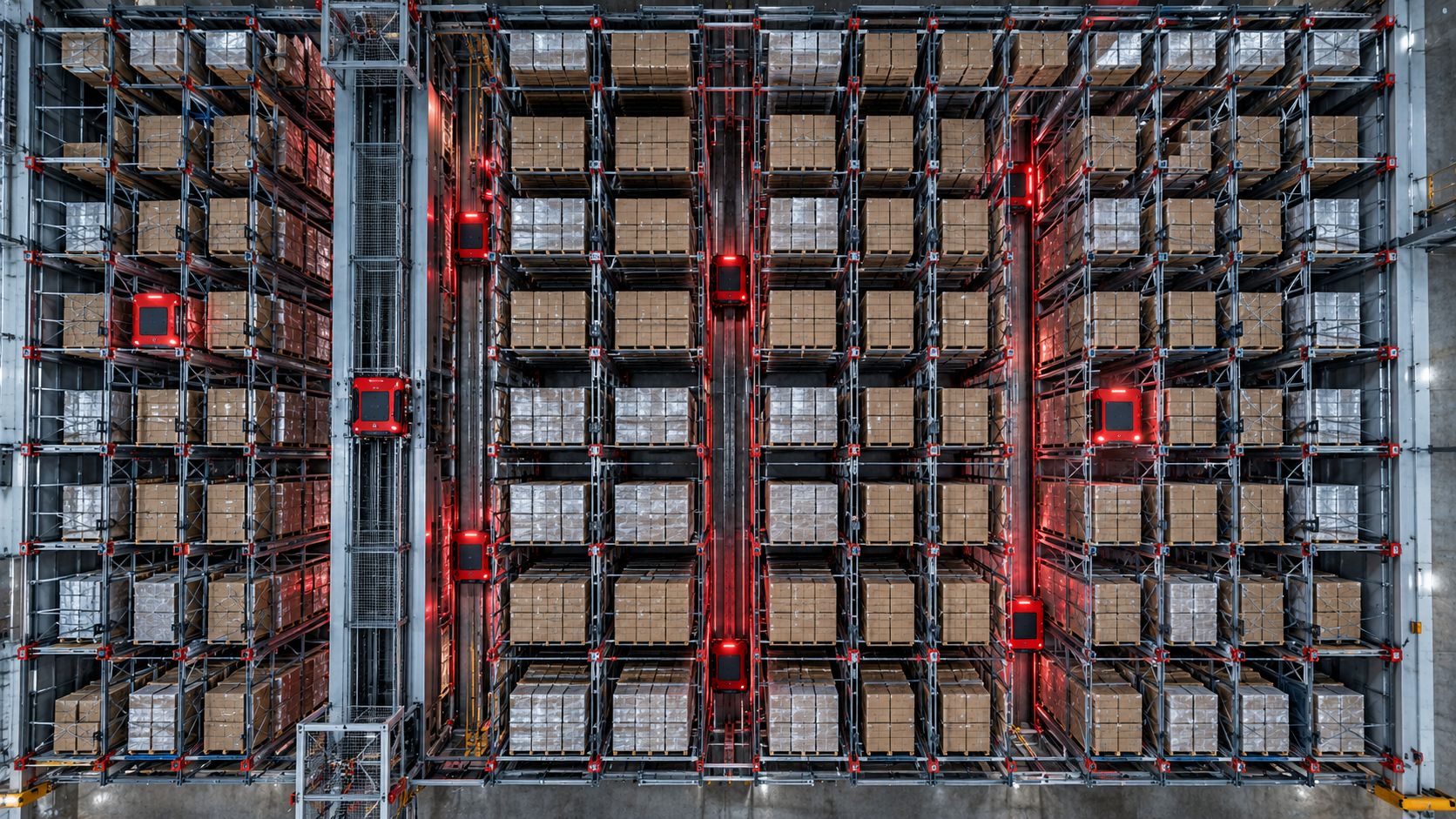
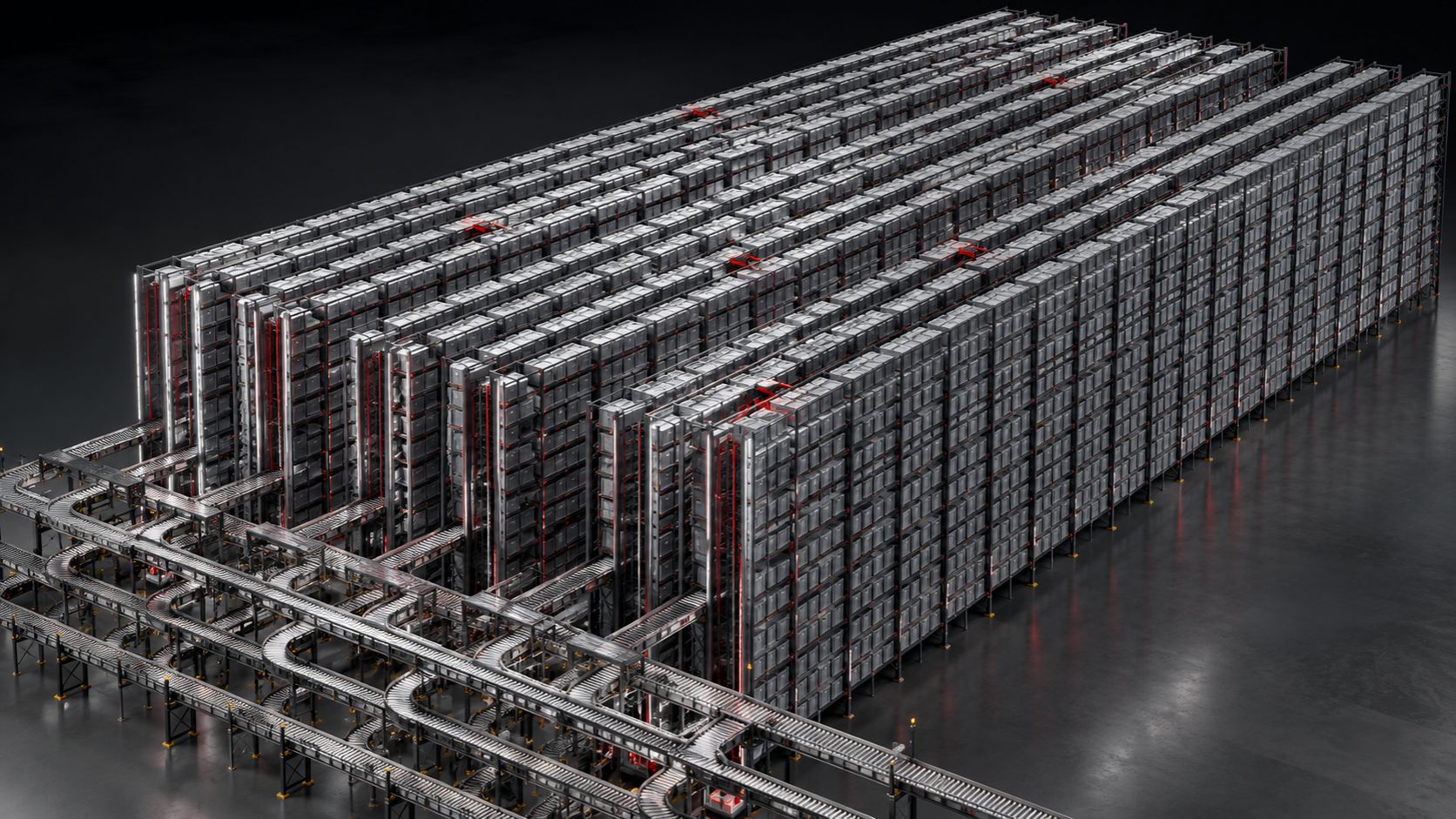
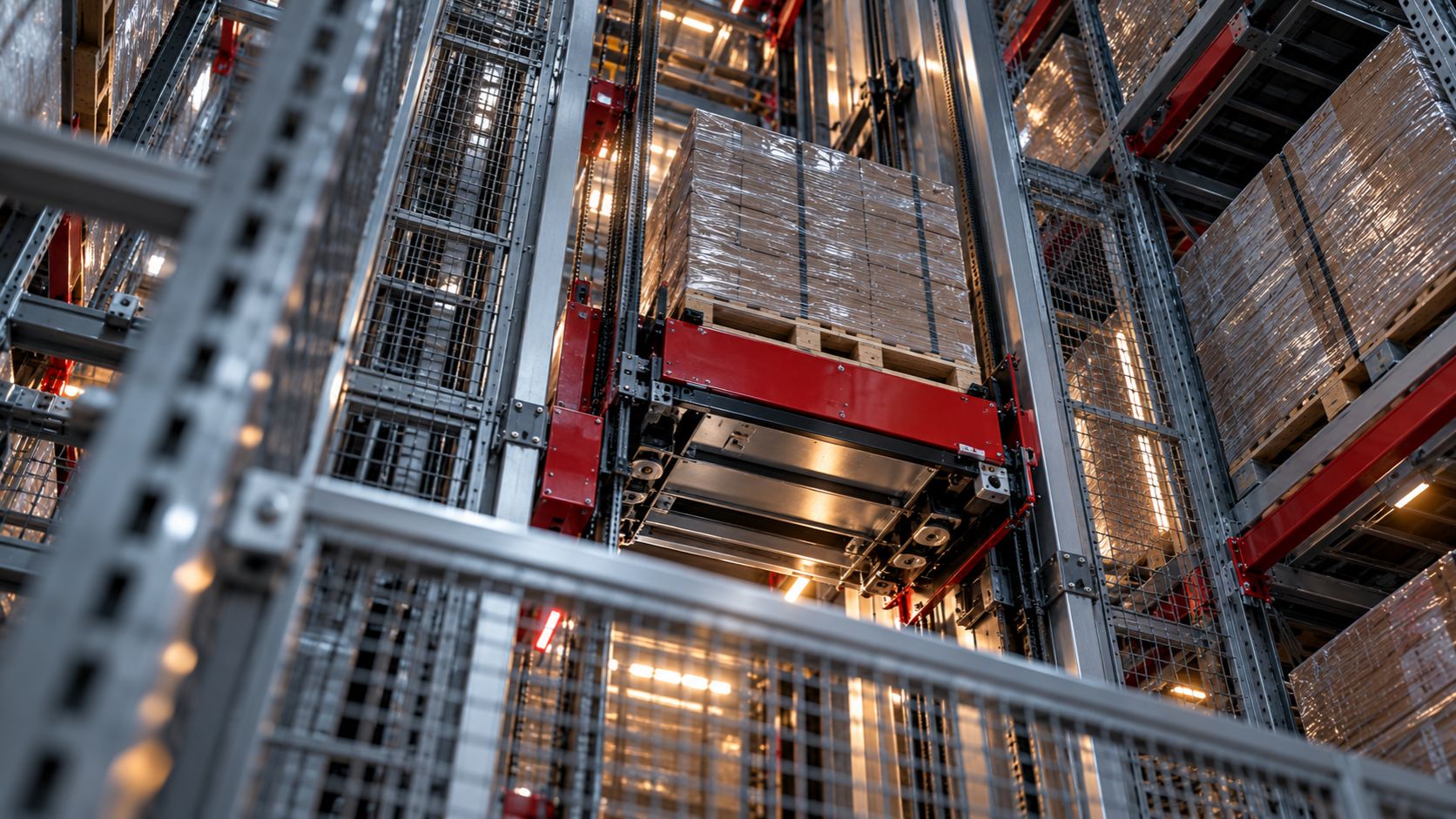
- In-rack shuttle systems: pallet shuttles, tote shuttles and lifts operating inside the rack grid itself. Relieves both aisle count and throughput ceilings at once, which is why automated storage and retrieval systems of this type dominate deep-lane projects. Compare lane depth in metres, payload in kg and lift cycles per hour.
Picking and handling robotics
- Pick assist: pick-to-light, voice picking, and RF scanning. Relieves accuracy and training burden without changing material flow.
- Robotic arms: palletising, depalletising and piece picking. Relieves repetitive lifting. Compare reach, gripper range and picks per hour by SKU profile.
The Software Layer Nobody Puts in the Equipment List
Equipment lists price steel, motors and controls. They rarely price the logic that decides what moves next, which is where throughput is actually won or lost.
Which layer owns which decision
The WMS owns inventory state and order data: what you have, where it is, what the customer asked for. The WES owns work sequencing and release, deciding which orders enter the system in which wave, at what priority. The WCS owns real-time device control, talking to shuttles, lifts and conveyors in milliseconds. The boundaries matter, and our breakdown of the warehouse control system versus WMS and WES maps where each decision should sit.
Why rate targets are missed in software, not steel
Mismatched layers are the most common reason an installed system never reaches its quoted rate. A WMS releasing work in storage-location order, with no WES smoothing, produces lift contention no hardware can absorb. For in-rack systems the WCS is decisive: lift sequencing, shuttle allocation and buffer logic set achievable cycles per hour, not the datasheet.
What to ask a vendor about control logic
Ask who owns allocation, whether sequencing is configurable, how the WCS handles a blocked buffer, and which integration standards apply.
Warehouse Automation Types Compared on Density, Throughput and Flexibility
Read this table by column, not by row. No single technology wins on all three axes, so compare warehouse automation types against the constraint that actually binds your site: cube, order rate, or the likelihood your SKU profile changes.
| Category | Typical load | Density effect | Throughput profile | Layout flexibility | Best fit |
|---|---|---|---|---|---|
| Conveyor and sortation | Cartons, totes, polybags | Neutral to negative (consumes floor) | High and steady, fixed routes | Low once installed | Stable, high-volume flows |
| AGV/AMR fleets | Totes, cases, pallets | Neutral; aisles stay walkable | Scales with fleet size | High | Brownfield, uncertain volumes |
| VLM and carousels | Small parts, trays | High in a small footprint | Modest per unit | Moderate | Slow-moving small parts |
| Stacker crane ASRS | Pallets, totes | High, one crane per aisle | Fixed per aisle | Low | Deep buffer storage |
| Pallet shuttle systems | Pallets | Very high, multi-deep lanes | Decoupled from aisle count | Moderate, modular | Dense pallet throughput |
| Tote shuttle systems | Totes, cartons | Very high, multi-level grid | High, parallel across levels | Moderate, modular | Goods-to-person picking |
The pattern worth noting: density and throughput only conflict when one machine serves one aisle. Shuttle architectures break that link by multiplying vehicles inside the rack, which is why they carry both columns while fixed-path systems trade one for the other.
In-Rack Systems Versus Floor-Based Robots: Where the Density and Throughput Actually Differ
Both architectures move the same pallets and totes. They differ in where the machine lives, and that single structural fact drives cubic utilisation and sustained cycles per hour in opposite directions.
Aisle width is the hidden density cost
A floor-based fleet needs drivable aisles, turning clearance at the ends of runs, and charging or parking space somewhere in the footprint. Every one of those is non-storage volume you pay rent and refrigeration on. Single-deep racking served by AMRs or AGVs therefore caps out at a predictable ratio of storage to floor area. In-rack pallet shuttle systems remove the aisle from the equation by storing lanes multi-deep and sending the shuttle into the lane instead of a vehicle down a corridor. The cube you recover is the cube the aisle used to occupy.
How throughput scales in each architecture
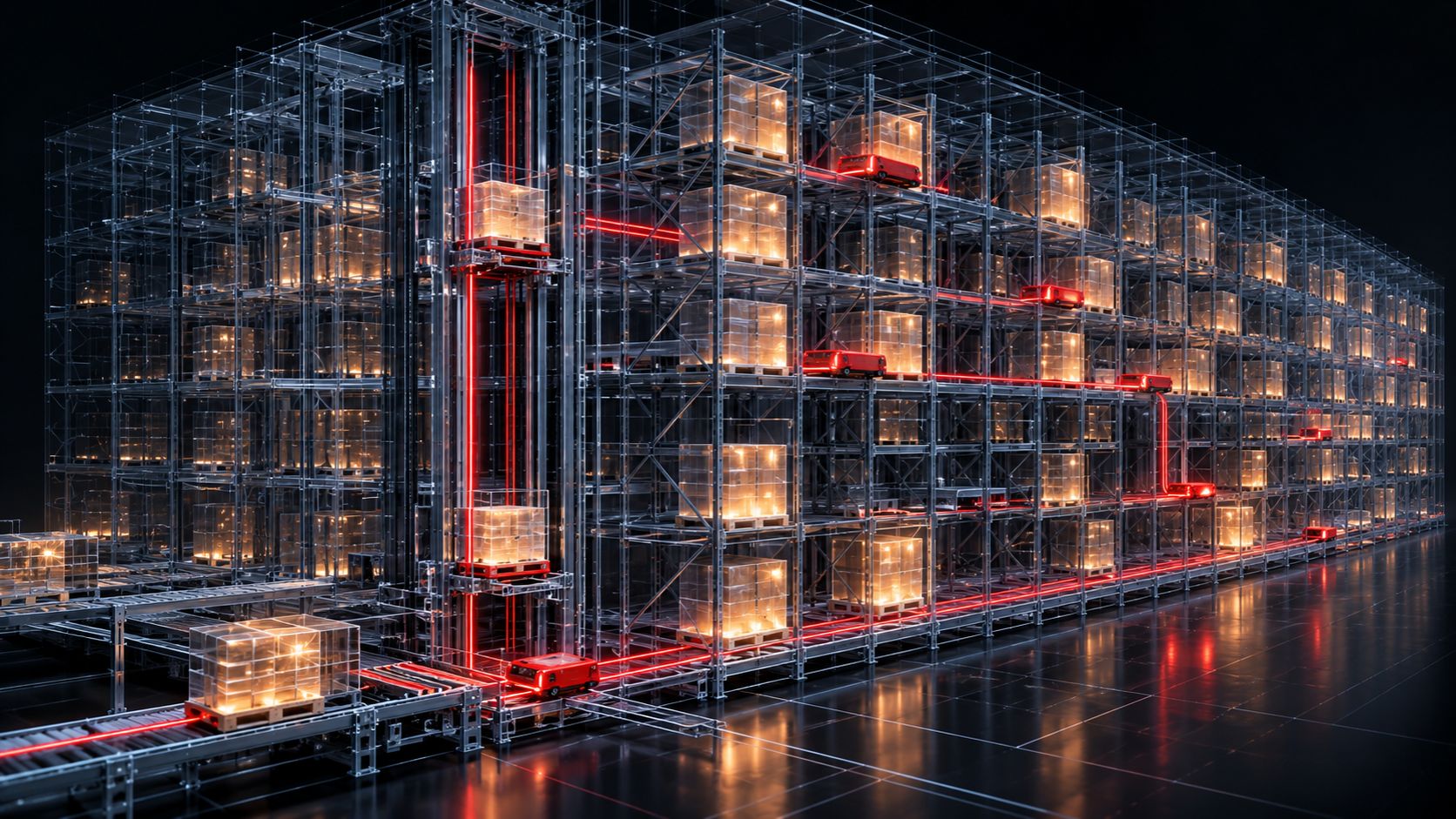
Floor fleets scale by adding vehicles, which eventually congest the same aisles and intersections, so each additional robot returns less. In-rack systems decouple the horizontal and vertical moves: shuttles handle lane travel, lifts handle elevation, and capacity grows by adding shuttles per level or lifts at the face. Throughput scales without consuming more floor.
Cold store and high-bay behaviour
Below freezing, battery performance, condensation and sensor reliability punish floor fleets. In-rack hardware runs on rails with fewer exposed variables, and at high-bay heights it reaches levels no counterbalance vehicle can safely serve.
When Conveyor, Mobile Robots or Plain Selective Racking Is the Better Choice
In-rack automation rewards depth, repeatability and volume. Operations that lack all three will pay for capability they never use. A vendor who cannot name the conditions under which their own technology loses is not worth trusting with a capital submission.
Low volume, high SKU variety
Tens of thousands of SKUs with a handful of units each produce shallow, fragmented inventory. Deep-lane storage needs homogeneous depth to pay back. Selective racking with a pick cart, or a goods-to-person cell handling only the fast-moving tail, will usually beat a full system on cost per line. Volatile case dimensions make this worse, because fixed load profiles and pallet dimension standards assume a repeatable footprint.
Short tenancy and uncertain growth
Under a three-year lease, or in a building likely to be vacated, mobile robots win because they move with you and scale in increments rather than one capex event. Clear height below roughly 8 metres also removes the vertical advantage that makes in-rack economics work.
Fixed point-to-point flow
Where product moves between two fixed points at steady volume, conveyor remains cheaper, simpler and easier to maintain. Do not automate storage to solve a transport problem.
What Each Level Costs, What It Returns and Which Process to Automate First
Capital intensity rises faster than headcount savings as you climb the levels. Mechanised handling is bought per metre. Shuttle and lift systems are bought per aisle, per tier and per throughput target, so the quote scales with your peak hour rather than your footprint. The useful question is not what a system costs but what each incremental level buys you in cases per hour and pallet positions per square metre.
Cost drivers buyers underestimate
Equipment is often the predictable part. Civil works, floor flatness tolerances, seismic bracing, in-rack sprinklers under the relevant NFPA storage standards, power distribution, integration with your existing host system and the commissioning window all land outside the machine price. Commissioning time deserves particular attention, because the weeks your building runs at partial capacity are a real cost that rarely appears in the model.
Trade-offs you accept at higher levels
Higher levels trade flexibility for performance. Fixed infrastructure assumes a stable SKU profile and carton dimension range. Lifts and transfer points concentrate risk, so redundancy becomes a design decision rather than an option. You also need maintenance competence resident on site, not a service contract and a two day response window.
Which process to automate first
Automate the highest repeatable volume with the worst labour dependency: usually putaway, buffering and sequencing, or replenishment to pick faces. Prove the data layer before adding steel, and approach building the automation business case on measured volumes.
Common Questions About Warehouse Automation Types
1. What is the difference between a semi automated and a fully automated warehouse?
A semi automated warehouse keeps people in the movement loop, with equipment assisting picks or transport. A fully automated warehouse removes operators from the storage and retrieval cycle entirely, so software decides every move and exceptions are handled by intervention, not routine labour.
2. Is an ASRS the same as warehouse automation?
No. An automated storage system is one category within warehouse automation, covering storage and retrieval specifically. Conveyor, sortation, palletising, print and apply labelling and mobile robots are all automation too, and most sites run several categories together rather than one.
3. Which type of automation gives the most storage density?
In-rack systems do, because the handling device travels inside the rack grid instead of needing aisles for a vehicle or operator. Multi-deep shuttle storage served by lifts converts aisle space into pallet or tote positions, which floor-based equipment cannot match.
4. Do I need a WMS before buying automation equipment?
You need accurate inventory data and defined processes before you buy, which usually means a functioning WMS. Automating on top of unreliable stock records simply moves errors faster. Confirm your data layer is sound, then specify the equipment around it.
Choosing the Level That Matches Your Volume, Not the Market’s Hype
The taxonomy in this article sorts automation two ways: by level, from mechanised handling through to lights-out operation, and by what the equipment actually moves, whether that is pallets, totes, cases or picked units. Those two axes are enough to place almost any system a vendor will show you, and they expose the fact that most proposals are not competing on the same dimension. A conveyor loop, a fleet of mobile robots and an in-rack shuttle system solve different problems, and the software layer determines whether any of them perform as specified once live order profiles hit them.
The decision rule does not change with the technology cycle. Match the automation level to three things: how stable your volume is, how hard your cubic constraint bites, and what throughput you need at peak rather than on an average day. If volume swings unpredictably and your building has room to grow, a lower level with more labour flexibility is usually the better financial answer. If you are cube-constrained, running consistent SKU velocity and chasing throughput that manual operations cannot sustain, that is where dense in-rack systems earn their capital. Stability and constraint, not ambition, set the ceiling.
The honest conclusion is sometimes a smaller one than a vendor would like to sell. Plenty of operations are better served by fixing slotting, replenishment discipline and inventory accuracy before buying anything, and plenty of others need one automated process rather than a whole site conversion. Automation amplifies whatever process logic it is given, including the bad logic. Sizing the system correctly is cheaper than discovering the gap in year two.
If you have throughput targets, pallet or tote volumes and a building footprint to work within, send those numbers to HWArobotics engineering and we will run a sizing discussion against them. You will get an assessment of what level fits, including the case for staying below it.