


The Robot Everyone Demos, and the Question Nobody Answers
No technology in this industry demos better than autonomous mobile robots. Ten units, a clear floor, a tablet showing live task assignment, and a pilot you can run in a corner of an existing building without touching the rack. That is why operations directors ask for them by name, and why the vendors who do this well have built genuine businesses on it. The demo answers the question of whether the robots work. It does not answer the question that actually decides the project: what you are paying in floor space and throughput per square metre to keep those robots moving. This article explains how the technology works, costs that arithmetic out honestly, and shows where a rack-grid alternative changes the numbers enough to be worth a second look.
How Autonomous Mobile Robots Actually Work
An autonomous mobile robot navigates by building and matching its own map of the building. LiDAR and depth cameras feed a SLAM algorithm that estimates pose continuously, a planner computes a route to the next goal, and safety-rated scanners interrupt that route whenever something enters the protective field. No infrastructure on the floor is required.
What SLAM navigation does differently
Simultaneous localisation and mapping lets the vehicle localise against walls, racking legs and structural features rather than against installed guidance. Path planning then runs dynamically: the robot reroutes around a parked pallet jack instead of stopping dead. That flexibility is the entire commercial argument for amr robotics, and it is also why performance degrades in environments where the map changes faster than the fleet can update it.
Sensors, safety scanners and stop distances
Protective fields are sized from speed, payload and braking distance under ISO 3691-4, so a heavier or faster unit needs a longer clear zone ahead of it. Engineers should press on two numbers: positioning repeatability at pick stations, typically specified in millimetres rather than centimetres, and docking accuracy, which is what actually limits conveyor or station handoff reliability.
Why an autonomous mobile robot is not an AGV
AGVs follow magnetic tape, inductive wire or reflector triangulation along fixed paths and halt when blocked. Free navigation is the defining difference, and it changes commissioning, layout flexibility and failure behaviour, as our AGV vs AMR vs in-rack comparison sets out.
The Main Classes of Warehouse AMR and What Each One Carries
“AMR” covers four distinct machine families with different payloads, duty cycles and building demands. Specifying the wrong class is the most common error we see in early concept work, and it usually traces back to a demo rather than a flow analysis.
Tote and carton transport units
Light decks, conveyor or roller tops, payloads in the tens of kilograms. They move single totes or cartons between zones and need the least from the floor.
Pick-assist and follow-me carts
Low payload, high interaction. These reduce picker walking rather than replacing it, so the gain is labour efficiency, not throughput capacity.
Shelf-pod and goods-to-person movers
These lift a mobile rack or pod and carry it to a station, typically in the hundreds of kilograms. They demand very flat floors, reserved pod fields and significant charging real estate.
Pallet and tugger AMRs
Fork or lift decks handling full pallets, commonly rated around 1,000 to 1,500 kg. Tugger units pull trains over long horizontal runs.
- Floor flatness tolerance tightens as lift height increases
- Aisle width must suit the turning envelope, not the chassis
- Charging bays consume otherwise sellable floor
- Fleet size scales with distance, not just volume
Compare these against other types of warehouse automation before committing, and review published floor flatness standards early.
Fleet Coordination: The Part That Decides Whether the Fleet Scales
What the fleet manager is really doing
The fleet manager handles two jobs simultaneously: task allocation (which robot takes which pick, based on position, battery state and current load) and traffic control (reserving path segments, sequencing intersections, resolving deadlock when two robots claim the same corridor). Deadlock recovery is the unglamorous part that separates mature software from demo-grade software. A robot waiting for a human to move a pallet jack is not a fault, it is Tuesday.
Why robot number 60 is slower than robot number 10
Throughput per robot declines as fleet size grows. Robots queue at intersections, aisle entries, chargers, lifts and pick stations, and congestion zones form exactly where the work is densest. Adding units past a certain point buys progressively less, which is why discrete event simulation matters more than datasheet speed.
Charging strategy and duty cycle
Opportunity charging at pick stations keeps robots available but consumes floor space and dwell time. Swap-free fleets need charger-to-robot ratios modelled against real duty cycles, not nameplate runtime.
Where WMS integration overruns
Most commissioning effort is integration, not hardware: order-release logic, wave sizing and the control-layer responsibilities covered in warehouse control system vs WMS and WES. Budget accordingly.
What Mobile Robots Genuinely Do Well
The strongest case for mobile robots is horizontal transport over long distances inside buildings that already exist. That is not a consolation prize. It is a real and common problem, and nothing else solves it as cheaply.
Cutting picker travel, not picking time
Pickers spend a large share of the shift walking, not picking. A robot that meets the picker at the face, holds the carton, and carries it to packout removes the unproductive leg without changing how anyone picks. Mobile robots in the warehouse also absorb volatility in labour availability: when a shift comes in short, throughput degrades gradually rather than collapsing.
Scaling capex in small steps
Units are bought in ones and twos, not in a single sanctioned project. Finance teams can match spend to demand, test a cell, and expand. If a layout changes or a contract ends, the fleet moves to another building. Fixed infrastructure cannot.
Deploying without rebuilding the building
Installation needs floor flatness, charging power, network coverage and risk assessment work, not structural steel or permits. Operating alongside forklifts and people in mixed traffic is where the safety case is strongest, because the robot yields rather than dominates.
The Problem Behind the Enquiry: Throughput per Square Metre
The metric that actually governs the business case
Nobody buys robots because they want robots. The enquiry almost always arrives with the same pressure behind it: more orders out of the same building, less dependence on a labour pool that is hard to staff, and a deadline set by a lease renewal or the next peak. Robots per shift is the wrong unit. The unit that governs the business case is cases or pallets per hour per square metre of building, alongside storage positions per square metre.
Rent, rates and the cost of a square metre
Every square metre carries rent, rates, heating, lighting and insurance for the whole lease term. Aisles consume that square metre without storing anything. With industrial rent growth still elevated in most logistics markets, floor given to travel paths is a recurring cost, not a one-off design choice.
When the constraint is storage, not transport
Reframed this way, the winning technology changes. If the bottleneck is moving goods across open floor, mobility wins. If the bottleneck is fitting more SKUs and more picks into a fixed envelope, density wins.
The Aisle Is the Hidden Line Item
Floor area spent on travel, not stock
Run the arithmetic on any robot-friendly layout and the same pattern appears. Selective racking with aisles wide enough for two-way robot travel, passing clearance and a safety margin around pick faces commits a substantial share of the floor plate to movement rather than inventory. Add charging bays, induction stations, buffer lanes and staging zones for inbound and outbound, and the storage footprint shrinks further. Exact ratios are layout-dependent, but the direction is consistent: the aisle is a permanent capital cost that never holds a pallet.
Why more robots do not create more locations
Throughput shortfalls tempt operators to buy more units. That decision adds traffic to a fixed aisle network, not storage positions. Beyond a certain fleet density, queuing at intersections and pick faces consumes the gains, a congestion effect well documented in traffic flow theory. The building holds exactly what it held before.
Clear height the fleet cannot reach
Floor-based units work within the reach of the person or lift mechanism they serve, typically the lower tiers of a high-bay building. Everything above that line is leased volume carrying no stock.
Comparison: AMR Fleets Versus Rack-Grid Shuttle and Lift Architecture
Rails instead of aisles
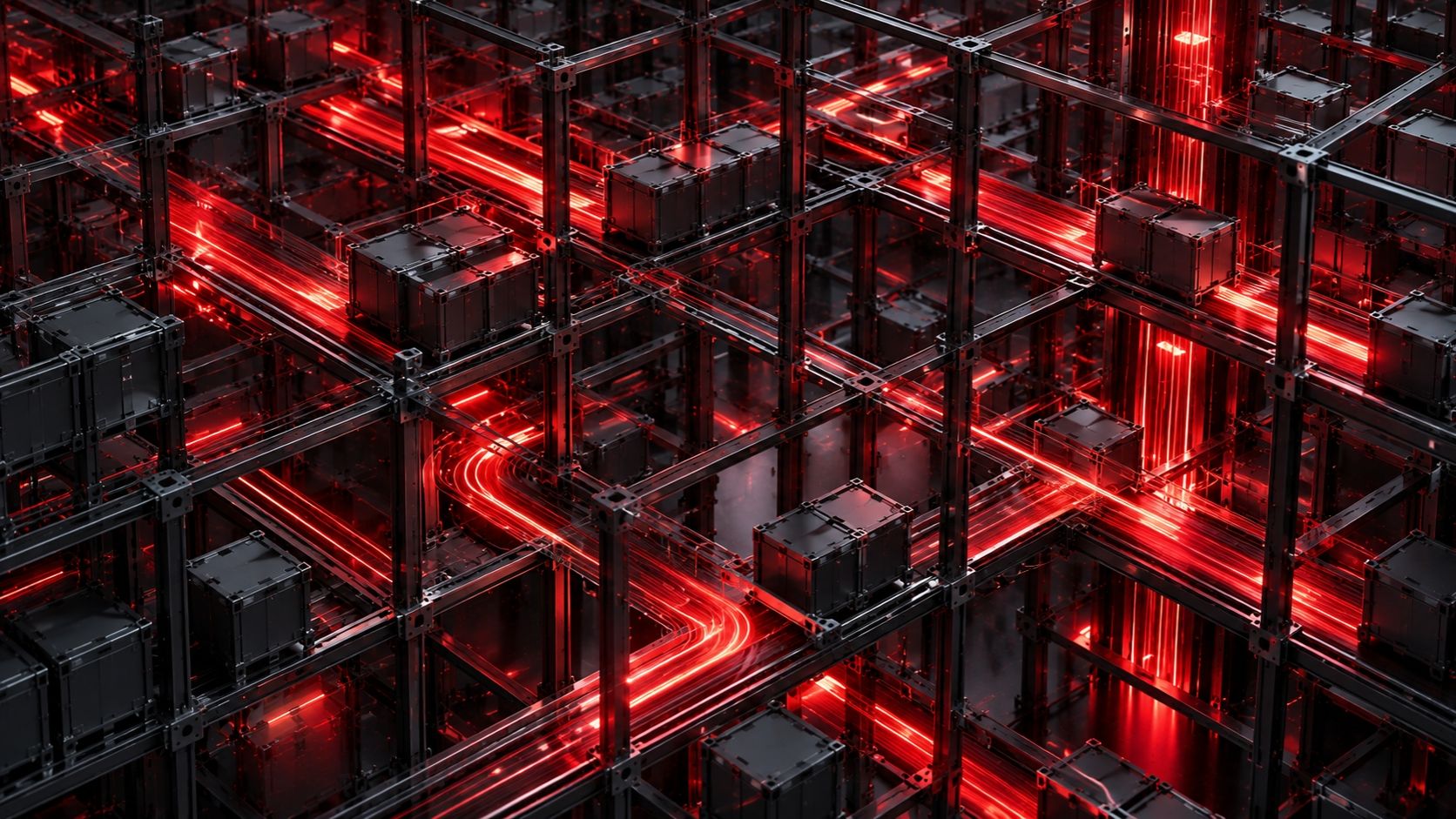
In-rack architecture inverts the geometry. Instead of a robot driving on the floor between racks, the shuttle travels on rails inside the rack at each storage level, and a lift handles all vertical movement at the aisle face. Lane depths of 10 to 40 pallet positions mean the travel path and the storage medium are the same structure. The aisle does not shrink, it largely disappears, and the building’s full clear height becomes usable rather than capped by what a floor robot can safely reach.
Where the throughput ceiling sits
A fleet’s ceiling is set by shared floor space: more units mean more interactions, more yielding, more queueing at the same pick faces. A pallet shuttle system scales differently. Throughput rises by adding shuttles per level and lifts per aisle, each operating on a dedicated path. Capacity is added without adding congestion.
Full clear height, deterministic cycles
Rail-guided motion gives repeatable positioning tolerance and cycle times you can model to the second, which matters when a line feed or sorter is downstream. It also matters in cold storage down to -25 °C, where battery performance degrades, charging windows stretch and operator exposure limits are real. Unmanned in-rack systems remove both constraints.
Side by Side: Floor Robots and In-Rack Systems
The trade-offs set out above, summarised across the criteria that usually decide the award.
| Criterion | AMR fleet | Rack-grid shuttle and lift |
|---|---|---|
| Navigation and guidance | Onboard sensing, dynamic paths | Fixed rails, deterministic motion |
| Floor given to travel | High (aisles and buffers) | Minimal |
| Use of clear height | Limited by mast or lift equipment | Full rack height |
| Throughput scaling | Add robots, congestion rises | Add shuttles and lifts per level |
| Density per square metre | Moderate | High |
| Deployment speed | Weeks | Months (civil and rack works) |
| Redeployability | High | Low once installed |
| Cold-store suitability | Battery and sensor constraints | Strong, unmanned operation |
| Best-fit duty | Variable, changing flows | Stable, high-volume flows |
Read the table as a split between flexibility and intensity. Floor robots buy optionality; in-rack systems buy cubic metres and cycles per hour.
When a Mobile Robot Fleet Is the Right Answer and In-Rack Is Not
Leases, layout churn and short contracts
If you do not control the building beyond the next few years, structural racking is the wrong asset to buy. A fleet moves out with you; a rack grid does not. The same logic applies to 3PL contracts with short tenure, volatile SKU profiles and operations where the layout changes every peak. Floor robots absorb that churn because the fixed infrastructure is minimal and the capex arrives in increments rather than one approval.
When transport distance is the bottleneck
Where the constraint is walking distance rather than stored positions, density buys you nothing. Long horizontal moves between zones, buildings or production cells are exactly what a fleet is built for, and low-to-moderate throughput rarely justifies lifts and shuttles.
Questions to ask before choosing
- How many years remain on the lease, and is renewal contractual or hopeful?
- What is the clear height, and how much of it is currently unused?
- What is the ratio of stored positions to daily order lines?
- Is the bottleneck travel time or cube?
- Does the capital approval process require phasing?
Questions Engineers Ask About AMR Deployments
1. How many robots does a given throughput need?
Fleet size is set by cycle time, not by pick volume. A robot completing a 200 metre round trip delivers a fraction of the moves per hour of one working a 40 metre loop, so the same throughput target can require very different fleet counts in two buildings. Model travel distance first, then divide.
2. Can AMRs run in freezer temperatures?
Some models are rated for chilled and freezer work, but battery performance, condensation on sensors and lens fogging all degrade in sub-zero air. Ask the vendor for a rated operating range and a duty cycle measured at that temperature, not at ambient.
3. What does the building have to provide?
Flat, level floor to a specified tolerance, clean lane surfaces, and continuous wireless coverage with controlled handover between access points. Patchy Wi-Fi coverage stalls robots mid-aisle.
4. Can AMRs and in-rack systems coexist?
Yes, and they usually should. Dense storage in the rack, mobile robots handling transport between zones.
Choose the Geometry Before You Choose the Robot
The vendor shortlist is the wrong starting point. Decide first whether your binding constraint is travel distance or storage density, because that one answer determines whether you spend capital on aisles or remove them from the layout entirely. If operators walk too far and your building has room to grow, floor robots solve it. If the building is fixed, the clear height is unused and the order lines keep climbing, aisles are the cost you cannot design around.
So bring the building, not a wish list: footprint, clear height, pallet or tote profiles, daily order lines and peak hour ratios. A layout study against those numbers tells you more than any demo. Our team can model your site against high density storage solutions when you are ready.