


Why This Question Deserves a Precise Answer
Ask five vendors what is warehouse automation and you will get five answers, each shaped to fit what that vendor happens to sell. A handheld barcode scanner gets called automation. So does a fully automated pallet store running hundreds of moves per hour without an operator inside the rack. Both descriptions are technically defensible, which is exactly the problem. Anyone early in research ends up comparing quotes that share a label but almost nothing else.
This page fixes that. It sets out a working definition you can actually use in a specification, then builds outward into the equipment families, the software layers that coordinate them, realistic cost structures, and the performance numbers that genuinely separate one system from another. Treat it as a hub. Each section points to a deeper guide when you are ready to go further than the definition.
What Is Warehouse Automation? A Working Definition
Warehouse automation is the use of machinery, control software and data to move, store and retrieve goods inside a facility with minimal manual handling and minimal manual decision-making. A system qualifies when it executes tasks and reports status on its own, without a human directing each individual movement. That combination of physical execution and software control is the warehouse automation definition worth using.
Automation versus mechanisation versus digitisation
Most sources collapse three different things. Mechanisation gives a human better tools: a counterbalance forklift, a gravity conveyor, a pallet jack. Digitisation gives a human better information: barcodes, RFID, a WMS with directed putaway. Neither removes the operator from the loop. True automation replaces both the muscle and the per-move decision. The distinction matters commercially, because mechanisation and digitisation projects are frequently sold under the warehouse automation meaning and then judged against automation-grade throughput expectations.
What has to be true for a system to count as automated
Three tests. The machine moves the load without a human on or beside it. The control layer decides sequence, location and priority from data, not from a supervisor’s judgement. The system reports completion and exceptions back without someone typing it in. Fail any one and you have assisted work, not automation.
Where most warehouses actually sit on the spectrum
Mostly in the middle: digitised inventory, mechanised handling, humans still owning the majority of decisions and every touch.

How an Automated Warehouse Runs, From Inbound Dock to Despatch
The stock journey step by step
A pallet arrives at the inbound dock and is identified by barcode or RFID scan against the expected receipt. The system assigns it a storage location, a conveyor or shuttle picks up the mission, and the load travels to a lift that delivers it to the correct rack level. It sits there as buffered inventory until an order line calls for it. On release, a retrieval mission is queued, the shuttle extracts the load, the lift returns it to the pick face, and sequencing logic presents cases in the order the packer needs them. Consolidation merges lines from different zones into one order, then packing and despatch close the loop with a final status report.
Which layer makes which decision
Every handover in an automated warehouse pairs a software decision with a hardware action. The WMS decides what moves and why, the WES orchestrates waves and balances work across zones, the WCS assigns missions to individual shuttles and lifts and tracks their status, and PLCs execute motion against safety interlocks. If you are unclear where one ends and the next begins, read our breakdown of warehouse control system vs WMS and WES.
Why islands of automation underperform integrated ones
Standalone machines optimise locally and starve each other. Integration through shared master data and one task queue is what makes the question “what is an automated warehouse” answerable as a system rather than a machine list.
The Main Families of Warehouse Automation Equipment
Catalogues present automation as a flat list of products. Buyers should read it as four architectural families, each with a different defining constraint. The division that matters most is physical: does the machine live on the floor and consume aisle space, or inside the rack grid where it does not? That single question sets your storage density ceiling before any software decision is made.
- Floor-based mobile robots: AGVs, AMRs and automated forklifts handle pallet and cart moves across open floor. Constraint: they need aisle and travel space, and throughput scales by adding vehicles, so fleet size grows with volume.
- Fixed transport and sortation: conveyor, shoe sorters and cross-belt sorters handle high-volume unit and carton flow. Constraint: the route is permanent, and cycle rate is fixed at commissioning.
- In-rack storage and retrieval: pallet shuttles, tote shuttles, lifts, stacker cranes and vertical lift modules handle deep storage. Constraint: lane depth, tier count and lift cycle rate, not aisle width.
- Goods-to-person and operator-assist layers: pick stations, pick-to-light, voice, wearables and computer vision govern pick accuracy and rate at the workface.
Floor robots and automated forklifts
Flexible, retrofittable, and the weakest performer per square metre because every vehicle needs room to drive.
Conveyor, sortation and fixed transport
Unmatched sustained throughput, poor tolerance for layout change. Review sortation system standards before specifying.
In-rack shuttles, lifts and cranes
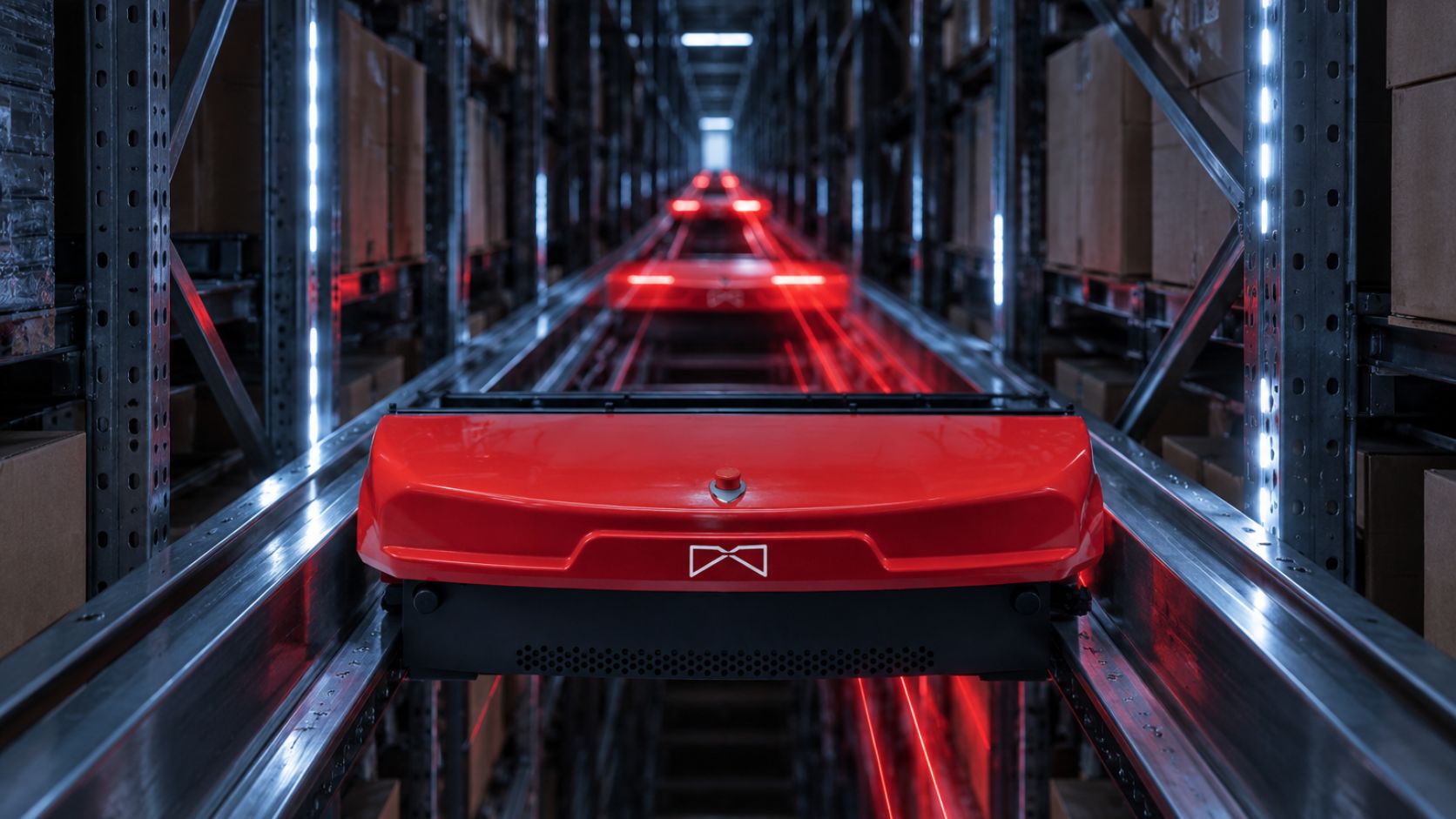
Density and throughput together, because the machine occupies storage volume rather than floor.
Picking aids and goods-to-person stations
Compare across the full types of warehouse automation before committing capital.
Automation Families Compared on Density, Throughput and Flexibility
The families differ less in what they carry than in where the machine lives and how throughput is added.
| Family | Typical load | Travel path | Density impact | Throughput scaling | Reconfiguration |
|---|---|---|---|---|---|
| Conveyor and sortation | Carton, tote | Fixed path | Neutral, consumes floor | Add sorter inductions | Low |
| AGV and AMR fleets | Pallet, tote | Floor aisle | Aisles retained | Add vehicles | High |
| Crane-based AS/RS | Pallet, tote | Fixed in-aisle | Aisles narrowed | Add cranes per aisle | Low |
| Pallet and tote shuttles | Pallet, tote | In-rack | Most aisles eliminated | Add shuttles and lifts | Medium to high |
| Robotic picking | Item | Fixed station | Neutral | Add stations | Medium |
Density and throughput are set mainly by where the machine lives and how many units can work in parallel.
Which Warehouse Processes Are Worth Automating First
Automation can touch every step in the chain: receiving, put-away, storage, replenishment, picking, sortation, packing, cycle counting and despatch. Few operations should automate all of them at once. The selection logic is narrower than most vendors admit. Automate the step with the highest number of repeated touches, the tightest time window, or the hardest floor space constraint. If a process fails none of those three tests, leave it alone.
Labour-constrained versus space-constrained operations
Picking normally carries the largest labour cost in the building. Storage normally carries the largest space cost. Those two facts point to different first projects, and the binding constraint decides. If overtime, agency spend and recruitment churn dominate your cost per order, attack picking and travel. If you are paying for a second site, external overflow or a mezzanine you did not plan for, attack storage density instead. Automating picking inside a building that has run out of pallet positions solves the wrong problem.
Picking, replenishment and sortation
These three interact. Faster picking without matched replenishment starves the pick face, and faster picking without sortation capacity simply relocates the queue to despatch. Review your current order picking methods before specifying equipment, because batch and zone strategies change the throughput target.
How the answer shifts by industry
A 3PL with changing client mixes prioritises flexible storage and reconfigurable sortation. E-commerce fulfilment prioritises picking rate against a courier cut-off. A cold store prioritises density and cycle counting, because every cubic metre is refrigerated and every manual hour inside is expensive.

What You Gain, What It Costs, and When Not to Automate
The gains and the mechanism behind each
Every benefit has a physical mechanism behind it. If you cannot name the mechanism, treat the benefit as marketing.
- Recovered floor space: shuttles travel inside the rack, so aisles that existed only for forklift access disappear and become stored pallets.
- Higher throughput per square metre: lifts and shuttles work in parallel rather than one vehicle serving one aisle at a time.
- Fewer handling errors: movements are instructed and confirmed by the WMS and WCS, not read off a label by a driver under time pressure.
- Inventory visibility: location data is a by-product of automated movement rather than a separate counting exercise.
- Safer work: people leave the cold store aisle and the high-bay picking face, which is where most serious forklift injuries originate.
The real costs beyond the equipment price
- Capital outlay concentrated up front, with payback measured over years, not quarters. Model it properly before committing, as our analysis of warehouse automation ROI sets out.
- Lead times measured in months for manufacture, installation and commissioning.
- Engineering and integration effort, especially at the WMS interface.
- Maintenance discipline, spares holding and trained technicians on site.
- Reduced flexibility. A dense system is tuned to a load profile and resists sudden change.
Conditions where conventional racking still wins
- Low daily volumes that never load the equipment.
- Volatile SKU profiles with unstable pallet or tote dimensions.
- Short leases with no renewal certainty.
- Buildings that cannot take the clear height or floor flatness and load.
How to Judge Throughput and Density Claims Before You Sign
Every vendor quotes a number. The number is only useful once you know how it was produced, under what load profile, and with which parts of the system counted.
Questions that expose a soft throughput figure
Pallets or totes per hour means nothing on its own. Ask whether the figure is single cycle (store or retrieve) or dual cycle (both in one move), because the two can differ substantially. Ask whether it is a peak burst or a sustained rate across a full shift with a realistic SKU spread, and whether lifts, conveyors and transfer cars are inside the measured loop or quietly excluded. Ask for the assumed lane depth, pick face location and replenishment ratio. A rate that only holds at a shallow depth or with a favourable order profile will not survive your despatch window. Compare vendors on the same simulation inputs, then look at how high throughput solutions hold their rate as depth increases.
The units a density claim must be quoted in
Require lane depth in metres, number of levels, clear height actually used, and pallets or totes per square metre of gross footprint, not rack footprint. Aisle count and travel distance belong in the same table.
Site conditions that decide feasibility
Get floor flatness and levelness tolerances in millimetres against recognised concrete floor tolerance standards, plus floor load capacity, rack alignment tolerance, operating temperature range for ambient, chilled or frozen duty, and power and network provision. Then agree availability targets, spares response times, and exactly what degrades when one shuttle faults.
Common Questions About Warehouse Automation
1. Is warehouse automation only for large operations?
No. The deciding factors are order volume stability, SKU profile and cost of land or labour, not company size. A single-aisle shuttle system inside an existing building can pay back for a mid-sized operation, while a large site with erratic demand may not justify one.
2. What is the difference between warehouse automation and an ASRS?
Automation is the broad category covering conveyors, sortation, software and robotics. An ASRS is one subset: machinery that stores and retrieves loads under software control without an operator driving it.
3. Does automation replace warehouse staff?
It changes the mix. Picking and travel roles shrink, while maintenance, controls and exception-handling roles grow. Most operators redeploy people rather than cut headcount outright, particularly where recruitment is already difficult.
4. How long does an automation project take from decision to go-live?
Expect months, not weeks. Design, manufacturing, installation, software integration and ramp-up each consume time, and building works or permits often set the critical path.
Where to Go Next in Your Research
The useful test is not how much robotics a site contains. It is where the machines live relative to the stored goods, which decisions the software owns rather than the operator, and whether the performance numbers are expressed in units you can audit: cycles per hour at a stated SKU profile, pallet positions per square metre at a stated clear height, availability measured over a full shift pattern.
From here, go deeper on the equipment families if you are still shortlisting technologies, on the ROI model if you are building the capital case, and on control software if you are mapping integration with an existing WMS. Those three threads decide most projects.
If you already have a building, a throughput target and a density constraint, bring the drawings and the order profile to us. We would rather argue about your numbers than repeat ours.